Sunday, October 18, 2009

In a Glass Darkly


If you are a fan of Edgar Allen Poe, you will probably enjoy this collection of five short stories and novellas by Sheridan Le Fanu. Tied together by the idea that each of these 'case histories' come from the files of a deceased doctor who specialized in the paranormal, each is capable of giving the reader the creeps.

'Green Tea', 'The Familiar', and 'Mr. Justice Harbottle' all revolve around the idea of paranormal visitation: the main characters are visited by something or someone that others can't necessarily see. And while I enjoyed each of these stories, it was the last two that make me recommend this for fans of horror and the occult.

'The Room in the Dragon Volant' is the longest of the stories and plays out more as a mystery story with supernatural overtones. It would have made the basis for a great Sherlock Holmes story and is truly suspenseful and eerie. While most readers will pick out that a double cross is in store for the narrator, it is hard to tell where it will come from.

'Carmilla' is a frightening tale of vampires that might pre-date Dracula. Le Fanu does an excellent job with description and pacing. Some of the descriptive writing ranks up there with Hawthorne from the same general time period.

The full text of these stories can be found here.

Vile Bodies


I am a fan of British humor. To me, the Brits have mastered the nifty trick of mixing the absurd with the very, very dry. Peter Sellers, Monty Python, and Ricky Gervais all come to mind. Evelyn Waugh, best known for his novel Brideshead Revisited, has also tapped into this reservoir of English comedy in his second novel, Vile Bodies.

Set in the years after the first World War, Vile Bodies centers on the character of Adam, a down on his luck writer who undergoes a series of reversals of fortune. He is in love with Nina, but alternately does and doesn't have the money to marry her. And while their up and down love affair is the focus, the novel is really a sharp lampoon of the 'jet set' of the day and their follies and foibles. Characters such as Mrs. Melrose Ape, the evangelist, Mr. Outrage, the Prime Minister, and the Drunken Major are on hand to act as a canvas for Waugh's broad swipes at British pre-war culture. All of the latest fads and fancies are on hand: zeppelins, motor races, parties, film making, and more parties. The juxtaposition between the old who are still trying to embrace Victorian morals, and the young, who are portrayed as vapid, yet resourceful, is one of the things that makes this novel stand out.

A particularly thoughtful point for me was the ending, which finds Britain at war in Europe, and the various fates of our characters seem fitting for the action that has preceded. Great stuff. The book was adapted into a film by Stephen Fry.

Saturday, September 19, 2009

The Last of Mr. Norris


This Christopher Isherwood novel was picked randomly off the list. I was intrigued when I found it on Amazon as they had one used copy in fair condition for $5 and two first editions for over $900! You can probably guess which I bought. I found out later that it can be found fairly readily as part of a two book collection called The Berlin Stories.

The cover of the version I have shows a man sitting on a couch with lots of young people around him engaged in some heavy petting. The blurbs on the cover promise lots of smut, orgies, and S&M, 1930s style. It turns out the book is very tame in regards to titillation. It is actually a pretty light spy/double cross/crime novel set in Berlin in the early 1930s. And while the title character does enjoy a little light bondage, most of the perversions promised on the cover are only hinted at in the text. Our narrator, Bradshaw, an English teacher in Berlin, meets Arthur Norris on a train to Berlin. They become fast friends and Bradshaw becomes intrigued by the effete, shady Norris. Slowly he becomes entangled in some of Norris' scams revolving around the nascent Communist party in Berlin and the rise of the Nazis. More interesting than the novel itself is the fact that this book and his subsequent Berlin stories were the basis for the famous musical and film Cabaret.

As a political thriller, it is fairly second-rate, although it is interesting to read a contemporary account of Berlin in between the wars from the English perspective, especially when the reader knows full well what will happen in a very short time. While this novel wasn't terrible, I'm not really sure how it merited making the list.

Saturday, September 12, 2009

Senor Vivo and the Coca Lord


Louis de Bernieres might be best know for Captain Corelli's Violin, a novel that was turned into a film starring Nicolas Cage. I haven't read that book, but it's a sure thing I will after having read Senor Vivo and the Coca Lord. This novel epitomizes the style of magical realism that is often associated with Latin and South American writers. The only catch is that although this book is set in South America, de Bernieres is actually British. One can assume that a teaching stint in Colombia led him to set his first three novels in that location.

Dionisio Vivo is a philosophy professor at a University in an unnamed South American country. He has begun to gain renown for the letters he sends to the local paper decrying the coca trade and its grim byproducts in his country. The local coca lord takes umbrage and makes several attempts on Dionisio's life. Through a series of mishaps, some extremely comical, Dionisio not only survives the attempts but earns a reputation as a godlike figure who is unstoppable. The coca lord lives in mortal fear of him, which only causes him to redouble his efforts to kill Vivo. Throughout all of this, Dionisio is courting a beautiful young woman, Anica, who is the daughter of a shady arms dealer who has kept the coca lord well stocked with weapons throughout his reign of terror. Anica is ultimately faced with a very difficult decision, which has tragic consequences for all involved.

This is my favorite book I have read in quite some time. The story is excellent, but it is the writing that leaves me wanting more. De Bernieres' prose takes the reader through the ecstasy of new love to the depths that lead a major character to attempt suicide. Meanwhile, the whimsical and sometimes magical world he creates is populated with memorable characters such as Ramon, the policeman who protects Dionisio, Lazaro, the tragic leper, and the motley band of women (Las Locas) who create a camp on the edge of town with the sole purpose of bearing Dionisio's children. The novel grows darker in the final third, and the magical elements step fully to the forefront. A very brief epilogue points out the tragedy of coca trade in South America and brings home how difficult the situation is. Laugh out loud funny and startlingly poignant, this one gets a very high recommendation from me.

Tuesday, September 1, 2009

The Brothers Karamazov


I hadn't been in the mood to tackle a long classic for quite some time, but early in August I decided to read Dostoevsky's last novel, The Brothers Karamazov. I've actually owned it for some time, but it has sat on the shelf as I waited for an opportune time to read it. I'm generally a very fast reader, and the book isn't that long (700 some pages), but it took me the better part of a month to get through it. That's not to say I didn't enjoy it however....

The book explores the lives of four brothers and their somewhat repulsive father, Fyodor Pavlovitch. Dmitri, the oldest, is a sensual being who is betrothed to one woman but in love with another. Unfortunately, his father is also smitten with this woman and is actively hoping to steal her away. Ivan is the intellectual, a deep thinker, and remote emotionally. Alexy is a spiritual young man who holds in highest esteem not his own father, but his spiritual father, a monk at the local monastery. Finally there is the servant and cook Smerdyakov, who is probably Fyodor's bastard. While the main plot of the novel centers around the murder of Fyodor Pavlovitch and the investigation into which son killed him, Dostoevsky's epic aims much higher than being a basic crime novel.

Dostoevsky was shooting for nothing less than a dissection of the modern (at the time) Russian man and his uneasy place at the intersection of politics, law, and religion. His use of psychology predates Freud and anticipates many of the Austrian's basic tenets in regards to the relationship between fathers and sons. There are long discourses on duty, responsibility, honor, religion, justice and everything in between interwoven into the main action. And while this causes the book to drag in places, there is no denying Dostoevsky's grand ambition. He clearly meant The Brothers Karamazov to be his crowing glory, and while I didn't enjoy it as much as Crime and Punishment, his reach did not exceed his grasp.

Monday, July 20, 2009

Miss Lonelyhearts/The Day of the Locust


Nathanael West produced only four novels during his short life. The best of the two are Miss Lonelyhearts (really a novella at 58 pages) and The Day of the Locust. I bought them packaged together in one book and read them back to back.

Miss Lonelyhearts is widely regarded as one of the finest works of the twentieth century. Set in early 1930s New York City, Miss Lonelyhearts is a man who writes an agony column for a daily newspaper. The hopelessness and hard luck that crosses his desk every day has begun to wear on him in significant ways. As he drifts through life in an alcohol haze, he vainly tries to find meaning in life, mostly through an attempt to embrace Christianity. His hard case boss Shrike and would be fiancee Betty offer contrasting views for him to latch on to. I had a mild hangover when I read this story, and the descriptions of drunkenness were tough to handle. The action is somewhat surreal, and as a look at the role of Christianity in an increasingly detached world, Miss Lonelyhearts works very well.

I enjoyed The Day of the Locust more of the two, however. What Miss Lonelyhearts did for (or to) New York, The Day of the Locust does in spades for Hollywood. West had moved to Hollywood to work on screenplays shortly before his death, and apparently he had a rich experience in a short time if this book is any indication. This novel captures the desperation, shallowness, and depravity of early Hollywood in all its glory. Tod Hackett is a young set designer with artistic ambitions who is hopelessly smitten by Faye, a wannabe actress. The story revolves around Tod and his fellow suitors (Earle, the cowboy, and Homer, the midwestern transplant) and their relative success in obtaining the unobtainable. In many ways Faye represents Hollywood in all its fatuousness: beautiful to look at, entertaining to be a part of, but ultimately hollow. The scene of mob violence at the end is truly evocative, and the book stands as an indictment as well as a strange celebration of the insanity of the place and era.

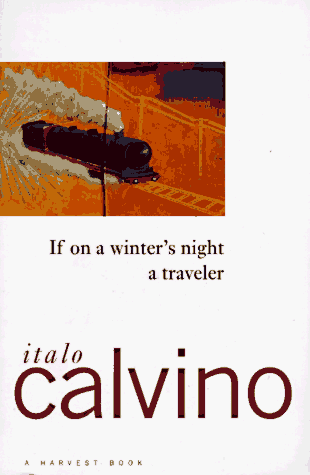
If on a Winter's Night a Traveler


Sometimes experimental fiction works for me, sometimes it doesn't. I loved Jealousy but disliked Cigarettes. If on a Winter's Night a Traveler falls squarely in between.

Italo Calvino's late 1970s novel is a considered a stone classic by most, but I had a very difficult time engaging with it. It was interesting and I admire his adherence to the conceit of the novel, but that wasn't enough to make me truly enjoy it. It's like a museum exhibit of interesting rocks- kind of nice to look at, but in all honesty, I could care less.

The novel is framed by the relationship between The Reader and the Other Reader and their attempts to finish a novel. Each time they become engaged with a story, a publishing error or some other problem thwarts them and they end up starting another story. And just as that story becomes special...... you get the picture. The ten novels the readers begin are all included here, all in different styles and genres. By the way, YOU are the reader and are addressed as such throughout. It's a bravura performance, but one that ultimately didn't work for me.

Sometimes, I just don't want to work this hard at reading a book.

The Hound of the Baskervilles


Sherlock Holmes is probably the most famous sleuth in history. While I prefer Hercule Poirot, Nero Wolfe and Perry Mason, Holmes is the template that they are all drawn from. With his skills of inductive reasoning, devoted sidekick, and his character tics, Holmes is the gold standard for whodunnit detectives.

The main issue with 'early' mysteries is that the puzzles are not terribly puzzling. None of the Poe or Arthur Conan Doyle stories can match the complexity and cleverness of Agatha Christie, Ngaio Marsh, or P.D. James, but they are very entertaining nonetheless. In The Hound of the Baskervilles particularly, Doyle is able to set a mood that is gothic and terrifying by letting his plot straddle the border of mystery and supernatural. Had Hawthorne written mysteries, this would be what they would be like.

The plot is fairly well-known. Wealthy family is haunted by a curse in which a hound from hell roams the misty moor that adjoins the family property. Now, Sir Charles Baskerville, a wealthy philanthropist, has been found dead, apparently frightened to death and surrounded by large paw prints. The new lord of the manor is moving over from Canada and Holmes takes it upon himself to unravel the mystery and protect the new Baskerville heir. The action is written in the first person by Watson, who shows his own bravery and cleverness a few times. A very fun read for a rainy weekend.

Disgrace


I had previously read J. M. Coetzee's Elizabeth Costello which I found to be dry and dull- basically a treatise on animal rights and the writing process, both of which are interesting topics, but not when handled in the 'novelesque' form used in that book. Disgrace was much better.

Coetzee, a South African and Nobel prize winner, writes here about David Lurie, a divorced professor whose affair with a student goes spectacularly wrong and who finds himself unemployed and at very loose ends. He decides on an extended stay with his daughter Lucy who lives alone on a relatively remote farm plot which she shares with Petrus, a black man with his own ambitions. Lurie has just begun to re-establish a relationship with Lucy and to understand her choice of lifestyles when the two are brutally attacked by a trio of young men. The heart of the novel lies in the various responses to this event by the main characters.

I really liked this novel because Coetzee is masterful at making the emotional barriers and distance between the father and daughter palpable. It is also an engaging meditation on the complexities of racial interaction in South Africa, post apartheid. The style is descriptive but economical, and Coetzee isn't afraid to feature a protagonist who is, on many levels, unlikable. Compelling.

Wednesday, July 15, 2009

Siddhartha


On a recent trip to Shakespeare and Co. Bookseller in New York, I picked up several Dover Thrift Editions which averaged about $1.50 each. One of these was Herman Hesse's Siddhartha.

Siddhartha tells the tale of the title character, a young Indian who lived in the time of Buddha. Siddhartha decides to leave his family to become a wandering ascetic and monk. Siddhartha is on a quest for enlightenment, but has a natural skepticism of teachers and teachings. He believes in discovery by the self. He meets a lovely courtesan who teaches him about material possessions and sensual pleasures. After many years, Siddhartha sees the pointlessness of his existence and returns to wandering, not knowing that he has impregnated the courtesan, Kamala.

Siddhartha meets a ferryman who inspires him to 'listen to the river' and Siddhartha begins yet another voyage of self-discovery, which is changed when confronted with his son after Kamala's death.

What saved this book from being too inward looking to bear is Hesse's very lyrical writing style. It reads like an ancient fable, but was actually first published in the 1920s. I'm glad I read this book when I was in my 40s. The themes of searching, of life as a cycle, and of the relationships between fathers and sons is something I feel I can truly appreciate at this time of life. For a book that I didn't enter into reading with any particular gusto, this was excellent.