Showing posts with label Award winners. Show all posts

Monday, July 20, 2009

Disgrace


I had previously read J. M. Coetzee's Elizabeth Costello which I found to be dry and dull- basically a treatise on animal rights and the writing process, both of which are interesting topics, but not when handled in the 'novelesque' form used in that book. Disgrace was much better.

Coetzee, a South African and Nobel prize winner, writes here about David Lurie, a divorced professor whose affair with a student goes spectacularly wrong and who finds himself unemployed and at very loose ends. He decides on an extended stay with his daughter Lucy who lives alone on a relatively remote farm plot which she shares with Petrus, a black man with his own ambitions. Lurie has just begun to re-establish a relationship with Lucy and to understand her choice of lifestyles when the two are brutally attacked by a trio of young men. The heart of the novel lies in the various responses to this event by the main characters.

I really liked this novel because Coetzee is masterful at making the emotional barriers and distance between the father and daughter palpable. It is also an engaging meditation on the complexities of racial interaction in South Africa, post apartheid. The style is descriptive but economical, and Coetzee isn't afraid to feature a protagonist who is, on many levels, unlikable. Compelling.

Friday, May 15, 2009

Everything Is Illuminated


If it seems like I'm reading at an incredible pace with all of these posts, I'm not- I'm just catching up by blogging about some of the books I read over the past several months but didn't have a chance to post about.

I don't know why it took me so long to tackle Everything is Illuminated. I read Jonathan Safran Foer's second book, Extremely Loud and Incredibly Close a few years ago and absolutely loved it. That book was one of the first that used September 11 as a background for the plot and it was a beautiful book.

Everything is Illuminated concerns a young Jewish man (also named Jonathan Safran Foer) who travels to Ukraine in order to learn about his family's heritage and specifically to look for a woman credited in family lore with saving his grandfather during World War II. Arriving in Ukraine, he is met by Alex, a young Ukranian, and Alex's grandfather who will serve as his guides, translators, and chaffeurs. Also along for the ride is Sammy Davis Jr., Jr., the family dog, whom Alex lovingly refers to as a "deranged seeing eye bitch".

The story is told through Alex's narrative and letters to Safran Foer, as well as through a book in progress that Safran Foer is writing regarding his family's history in the semi-fictional village of Trachimbrod. These elements are skillfully woven together, although the device feels a bit self-conscious at times.

One of the major charms of the novel comes in the character of Alex, or more specifically, Alex's broken English and syntax. His writing reminds me of how some of my students will use 'big' words that are synonyms for his intended meaning, and yet somehow miss the mark. Once you capture Alex's cadence, you are in for some laugh out loud moments. This is actually quite a funny novel, but one that also reminds us of the atrocities of the second World War and the lasting damages that resulted from it.

I liked this book, although I liked the follow up novel more. Safran Foer is clearly a very talented writer, but some of this was too clever by half. The novel was turned into a film with Elijah Wood and also won a Jewish Book Award for Fiction.

Monday, March 2, 2009

The Blind Assassin


Margaret Atwood was another author I'd heard a lot about but I hadn't gotten around to reading one of her books until I picked up The Blind Assassin. Apparently, Atwood has been labeled as a science fiction writer, a label she bristles at. I remember one of her books, The Handmaid's Tale, was made into a well-received movie a few years ago.

The Blind Assassin is a story within a story within a story. If that puts you off, don't let it. Although there are parts of this story that unwrap mysteriously, it is the author's intent and not just a confusing structure to the novel. It contains elements of mystery, tragedy, drama, and, yes, science fiction.

The novel (which won the Booker Prize 8 or 9 years ago) centers around Iris Chase Griffin, a Canadian woman whose family were once preeminent manufacturers of gloves and other garments until the depression and hard times caused a slow slide from wealth. Iris and her sister Laura are left to be raised by their father and servants after their mother's untimely death. As the narrative of the sisters' lives unfolds, we are introduced to a story within the story, a tale of two lovers meeting in clandestine locations, the man in the relationship improvising a science fiction story that has kept the woman enthralled for months.

Iris' sister Laura dies in a car accident and shortly afterward, her husband is found dead in a sail boat. Are the two incidents related? And who are the lovers in the story 'The Blind Assassin' (revealed to be a posthumous work of Laura's)?

Atwood is a brilliant writer. The plot was well-planned out and engrossing. She is able to skillfully weave the narratives from the 1930s and 40s into the present day as well as including the cut-aways to the story within the story. A tale of identity, secrets, trust, and family, I had a hard time putting this down. This novel was deeply satisfying, deserving of its accolades, and an excellent way to while away a couple of afternoons.

Sunday, January 18, 2009

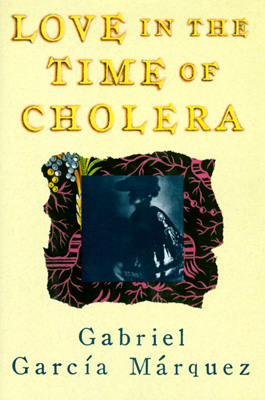
Love in the Time of Cholera


One of the things I like about following 'The List' is that it encourages me to finally read books by authors whose work I am familiar with, but have not read. Toni Morrison was one such author and Gabriel Garcia Marquez is another. I read his non-fiction News of a Kidnapping several years ago and enjoyed it very much, but this was my first foray into his fiction.

Love in the Time of Cholera is one of Marquez's best known works. It has been an Oprah choice, a major motion picture, and is the book people seem to mention most often in relation to this Colombian writer. The story literally covers the lifetime span of the major characters, the lovesick Florentino Ariza and his fifty year obsession with Fermina Daza. The book takes place in the late nineteenth and early twentieth century in an unnamed city on the Mediterranean. Florentino Ariza was the youthful suitor of Fermina Daza who took great pleasure in clandestine correspondence and hopeful talk of the future with Florentino. However, maturity and events lead her instead to marry Dr. Juvenal Urbino, a well-connected local doctor and philanthropist. Florentino Ariza decides to 'wait' for Fermina Daza, hoping that someday, should the good doctor die, she will eventually be his. Florentino has 600 'temporary' flings while waiting for her and leads what appears to be a conventional life to the outside world. However, his entire existence is based around waiting. And waiting. And waiting for Fermina Daza.

The book is a beautiful but challenging read. There is almost no dialogue and the detailed descriptions can be off-putting for some readers. I found that as long as I had a solid chunk of time to devote to it, the novel was great to read. This is definitely not one to pick up in dribs and drabs.

The best thing about this book for me was the subtext. On the surface, it is a relatively straight-forward meditation on the power and endurance of love. Still, I feel that there is a lot more happening than that. The character of Florentino Ariza inspires our sympathy, but when his actions are looked at objectively, he comes off more like a deranged stalker and terrible user of women- not the romantic figure he cuts on a surface reading. The book also tackles some of the enduring questions about old age and the many different faces of love. Definitely worthwhile to read, and one I've spent a lot of time thinking about since I put it down.

Saturday, January 3, 2009

Song of Solomon


Toni Morrison is another lion of modern literature. Although her output is modest compared to some others of her generation, the quality of that output was high enough for her to earn just about every literary award there is, including the Nobel Prize in Literature. Still, as with many other authors of her caliber, I had yet to read any of her work until this year.

Song of Solomon is an amazing book and I'm glad it was the first Toni Morrison novel I read. The book is really about identity, especially identity for African Americans who are only able to trace their lineage back so far. The dedication reads, "The fathers may soar And the children may know their names".

The story concerns the Dead family: Macon, his wife, his son, and his two daughters in addition to his sister and her daughter and granddaughter. The main character is son 'Milkman' Dead (so named because of the fact that he breastfed until he could stand on his own feet). The story follows Milkman throughout his life from his younger days as a constant source of disappointment to his father through his joining and maintaining the family business and finally through his search for his grandfather's true identity. Along the way we meet an amazing cast of characters: First Corinthians and Magdalene called Lena, Milkman's sisters; Pilate, his semi-divine aunt; her daughter Ruth and her granddaughter Hagar who falls hopelessly and dangerously in love with Milkman.

Milkman's best friend Guitar offers a contrast to Milkman in both mission and temperament. While Milkman spends the majority of the book thinking of his own needs and trying to get ahead, Guitar has been led to a different path. Guitar belongs to a group that is trying to level the playing field between whites and blacks, with a surprising way of how to accomplish that.

The ending is somewhat ambiguous, but very satisfying. Milkman, facing Guitar down, learns to truly embrace the legacy of his grandfather's people as he learns to fly.

The story of this novel is excellent, but it is Morrison's prose that makes it so fantastic to read. It takes a couple dozen pages to fall into her cadence, but once you do, the story flows by like a river. I read a lot of books this year, but this one will definitely stand out in my mind for many years to come.

Sunday, October 26, 2008

The Corrections


Jonathan Franzen raised a fuss a few years ago when Oprah selected this National Book Award Winner as an entry in her famous book club. Franzen objected, indicating that Oprah's club members were lemming-like in their voracious appetite for any literature that was O-approved. Oprah withdrew the selection, no doubt instantly erasing millions in potential income from the balance sheets of both Franzen and his publishers. The book was a major best-seller anyway.

The Corrections is about the Lambert family, a brood brought up traditionally in the American midwest. While there apparently is nothing terribly special about this respectable middle class clan, their lives are unraveling terribly by the time the children reach adulthood. Father Alfred is battling against dementia and Parkinson's; his wife Enid is barely coping and wondering why her children are so distant. Son Gary is clinically depressed, living with his family in Pennsylvania and wondering where it all went wrong. Chip is a disgraced college professor, sponging off of girlfriends and wondering where his next break will come from. Denise is a well-known chef whose personal life involves breaking up marriages by seducing the male and female parts of the couple. As Alfred slides towards complete dementia, Enid longs for one last Christmas, with all of the family together in the family home. Sounds like a set up for a tale about a bunch of lovable losers who somehow manage to maintain our compassion and empathy. But......

I never really came to care about any of the Lamberts, with the possible exception of Alfred, an absentee father and non-communicative spouse. Alfred takes a bit of the brunt of blame for all of his family's problems- unfairly so in my estimation. While there are some great vignettes and the dialogue is strong, the story is just disjointed enough that it tested my patience. And I like big, sprawling, all-over- the-place novels as a general rule, but I have to care about the characters, and this time out I did not.

One of the problems is that Franzen can be too clever by half. He is clearly extremely intelligent, and much of the book is very well-researched. He writes with authority on a number of topics, from railroad engineering to commercial kitchens. Unfortunately for me, a lot of it came off as show, and did little to move the story or the characters forward. The book could have used substantial editing.

While I wouldn't classify it as a waste of time (and, after all, the book has been very successful; clearly someone likes it), I had high expectations which The Corrections failed to live up to.

The Story of Lucy Gault


This novel, shortlisted for the Man Booker Prize in 2002, is a haunting story of missed connections and the long-lasting effects our impetuous mistakes can have on our lives.

Lucy Gault is a young girl living an idyllic life with her mother and father in 1920s Ireland. Because her mother is English, the family has been targeted by Irish activists and lives under the threat of violence. Her father, Captain Gault, decides it is time to move the family to England. In order to delay or postpone the move, Lucy decides to hide in the woods on moving day. Through a series of plausible coincidences, she is believed to have drowned in the sea. Heartbroken, her mother and father move away, wandering Europe aimlessly, and more important, without permanent address.

In actuality, Lucy was injured in the woods, and is found barely alive after her parents are gone. So begins a lifetime of patience, of waiting, of self-denial, of loneliness, and of forgiveness. Thematically, it reminds me of McEwan's Atonement.

William Trevor hits all the right notes while touching on many major themes in this book. There are a lot of big ideas, but he does not hit you over the head with them. The words seep into you and imbue the reader with a sense of melancholy, but of continuous hope- much the same feelings that Lucy experiences throughout the novel. Very skillfully plotted and hard to put down.

Thursday, October 2, 2008

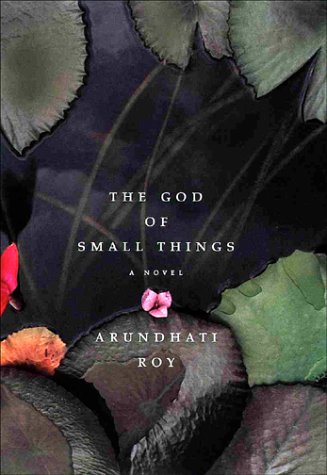
The God of Small Things


Arundhati Roy's The God of Small Things is a Booker Prize winner, a wonderful feat for a first novel. The writing is fluid, descriptive and beautiful. Set in Kerala, India, the novel is about an Indian family that is going through a slow change in fortune. Ammu has moved back to her family's home with her twins, Rahel and Esthappen, products of an undesirable marriage that has caused great consternation within her family. Her mother and aunt run the house while her brother Chacko runs the family food business, a pickling and canning company. The novel opens with the funeral of their English cousin, Chacko's daughter Sophie Mol. The plot of the novel unfolds towards the death of poor Sophie Mol, creating great suspense even though the ultimate outcome is known. The fallout from this event shadows the lives of every member of the family. While this book in many ways can be read as an indictment of the caste system, its focus is more personal than public, and it is the character's search for forgiveness and redemption that drives the novel.

I have to say that I love the plot device in books like this: a known ending and suspense and interest that lies in how we are going to arrive at that ending. Roy's writing is very fluid, mixing a sense of traditional storytelling with very modern incursions. She builds believable and flawed characters who the reader comes to care about. There is a sense of melancholy and tragedy that hangs over the entire work, although there are lighter, almost comic moments. She does an especially good job of putting the reader at home in a part of the world that might be entirely foreign. My understanding is that Roy has given up writing to become a full-time activist. Noble as that is, it is a shame we don't have more stories like this one from her.

Monday, September 29, 2008

The Amazing Adventures of Kavalier and Clay


This one, by Michael Chabon, is definitely a favorite, and is a favorite of many of my friends. It's a perfect novel in a lot of ways: memorable characters, sharp plotting, originality in spades, and a storyline that creates a compulsive page turner. This is probably my favorite novel of the past 7 or 8 years.

The plot involves the story of Joe Kavalier, a Jewish teen who escapes from Prague and lands in New York where he hooks up with his cousin Sammy Clay. Sammy, an idea man, is excited to learn that Joe is an artist of some talent, and together they immerse themselves in the world of a beloved 1940s American development: the comic book. Clay remains rooted to his love of the comic, superheroes, and his own 'secret identity', while Kavalier takes a rockier path in his relationships and his own quest to find himself.

While ultimately it is the story and the characters that make this novel so compelling, it really is just a big long love letter to America, and more importantly, the ideal of America; that two kids, one an immigrant, the other an all-American nobody, could transcend class and station to become American success stories. The novel also examines the tricky territory of identity in America, and how individuals can reinvent themselves as they see fit. The Amazing Adventures of Kavalier and Clay is an affirmation of the American dream, and a memorable example of a novelist working at his prime. Chabon won the Pulitzer Prize for this book, and in my opinion deserved it.