Sunday, May 31, 2009

The Great Gatsby


I first read The Great Gatsby when I was 11 or 12. I remember seeing it on my teacher's desk and asking her if I could borrow it, probably trying to be precocious. I read it, but it may as well have been the Rosetta Stone. A young kid from eastern Washington had no conception of the New York locale (an essential part of the novel) or of the historical context it stood in. So of course, I hated the book and made sure that I kept that opinion for the next 30 years.

Embarking on the List, I knew there would be a few books that I'd need to reread in order to 'count' them, and this was one of them. I'm glad I gave it a second appraisal.

The novel is set in 1920s New York and Long Island and concerns the experiences of Nick Carroway, our narrator, over the course of a year he spends attempting to become a bonds trader. Nick's second cousin Daisy and her husband Tom live just across the bay from him and he strikes up a romance with their house guest, a female professional golfer. Nick's next door neighbor is the enigmatic Jay Gatsby, a man with a taste for incredibly opulent and frequent parties and a mysterious past. Over the course of the novel, his love for Daisy is revealed and his obsession with winning her from her two-timing husband leads to tragic consequences.

As most people know, The Great Gatsby concerns the American dream, or, more accurately, the artifice of the American dream. It can definitely stake a claim as the Great American Novel. The character of Gatsby is both the realization of the American dream and the representation of its hollow and tenuous promise. The same can be argued for Daisy and Tom who have succeeded, but have done so through very little effort on their own parts. Gatsby is self made, but not in a way that will ever be respected by the likes of Tom, or, to a lesser extent, Nick.

I was interested to learn in my research that F. Scott Fitzgerald was considered somewhat of a failure during his life. After a huge success with his first novel, Gatsby sold only 25,000 copies while Fitzgerald lived, and he wasn't appreciated fully until after his death when his work was reappraised and began to become a standard piece of high school and college curriculum. Fitzgerald, a member of the 'Lost Generation', died very young as a result of his alcoholism. His wife Zelda died in a fire in Asheville, NC just a few years later.

Alice's Adventures in Wonderland


Another classic children's tale I never bothered to read as a child. In fact, although I must have seen the classic Disney animation at some point in my life, I have no recollection of it. I was on the Alice ride at Disneyland when it broke down one time, but that's another story.

Much of my knowledge of Lewis Carroll comes from John Lennon's admiration of him and the inspiration it gave him in his writing and music. I thoroughly enjoyed reading this for the clever use of language and the whimsy of the story. However, nothing much really happens in the story. There isn't a plot arc to speak of as much as a series of indelible character sketches: the White Rabbit, the Doremouse, the Mock Turtle, the Queen of Hearts, the Cheshire Cat, the Mad Hatter, the Gryphon, etc. have all become part of western popular consciousness.

Carroll's personal life has been a matter of speculation, with dueling academics debating whether or not he was a pedophile and wondering why there are missing pages from his otherwise well-maintained diaries. Carroll (a pseudonym for Charles Dodgson) was also a brilliant mathematician and led by all accounts an interesting life.

I plan to read Through the Looking Glass soon for the further adventures of Alice.

Friday, May 29, 2009

The Bell Jar


I honestly had no idea what to expect of The Bell Jar. I knew who Sylvia Plath was and how she died, but I know of her as a poet and was actually unaware that she had published any novels. In all honesty, I thought The Bell Jar would be a collection of poetry. Instead, it is a novel that seems to be from the Holden Caulfield school of narrators who have disengaged from life after seeing the pointlessness of the whole thing.

Esther Greenwood is a young woman who has regularly achieved academic excellence and at the beginning of the novel is on a month long internship for a New York based magazine. In the first half of the novel, Esther relates her adventures in New York, some comic, some sad. She feels separate from other people, but not in a way that is particularly different than what most people go through from time to time. However, once she returns home to find that she did not get accepted into a writing program as she had anticipated, things take a terrible turn and she attempts suicide. The second half of the novel is a harrowing first person description of a nervous breakdown in action. While the novel ends on a hopeful note, the subsequent tragedy of Plath's life leaves the reader feeling that the hopefulness will be short lived.

After reading and researching, I now understand that The Bell Jar is largely autobiographical. Virtually everything and everyone in the story mirror real events and people in Plath's life. In fact, before she died, Plath insisted the novel not be published in the United States and was only published in the UK under a pseudonym. One feels slightly uncomfortable reading the novel knowing that it is a relatively true account, especially when one knows the rest of the story and the relief that the narrator has survived her ordeal is undercut by the knowledge of her ultimate fate.

Thursday, May 28, 2009

Farewell, My Lovely


"I got up on my feet and went over to the bowl in the corner and threw cold water on my face. After a little while I felt a little better, but very little. I needed a drink, I needed a lot of life insurance, I needed a vacation, I needed a home in the country. What I had was a coat, a hat, and a gun. I put them on and went out of the room."

Farewell, My Lovely is entirely built of this type of prose, lyrical and purple at the same time. I discussed earlier how difficult it is to read a hard boiled detective tale because of the constant satirizing and diminishing returns of the genre. Still, after Dashiell Hammett and Sam Spade, the quintessential L.A. hard case has got to be Raymond Chandler's Phillip Marlowe. When a character is portrayed in film by people like Robert Mitchum and Humphrey Bogart, you know he's tough.

Farewell, My Lovely was the second of Chandler's Marlowe novels. It follows a case of gambling, drugs, and murder in 1930s Los Angeles and environs. Along the way there are dames, psychics, disreputable cops and doctors, and a double cross or two for good measure. Chandler is particularly good at description and Marlowe in his first person narration is the conduit for these descriptions. Marlowe becomes enmeshed in the action by simple coincidence, but is able to play just the right moves in order to crack the case. Chandler hints at Marlowe's alcoholism without dwelling on it and also shows him to have racist tendencies. In fact, some of the racism is shocking to a modern reader, but is somehow different than that of the Tarzan novel. Here, the racist remarks are in keeping with the character, as opposed to being a simple premise that the action is based upon.

As with much of the genre, the mystery itself is no great shakes, but Chandler's writing is evocative and I'll look forward to reading more.

Brighton Rock


Graham Greene is yet another prominent twentieth century novelist that I have been aware of but had not read. Brighton Rock is his 1938 novel about seaside thugs and their struggle for power over Brighton and its horse track.

Pinkie is a seventeen year old whose world stretches no further than the beachfront and horse track in Brighton. He has inherited control of a gang after its leader was killed. Despite his young age, Pinkie's ruthlessness and quick mind make him a natural for succession. The far wealthier Mr. Colleoni has his own ideas on who should handle the action in Brighton, and a struggle for control ensues. Against all this is Pinkie's relationship with Rose, a naive waitress who has information that might link Pinkie and his gang to a murder. Unfortunately for Rose, she has no idea what the information really means and is 'romanced' by Pinkie who has aims at marrying her simply so she cannot be forced to testify against him.

The real interest in this novel for me was the character of Pinkie, who must have been relatively unique for his time. Like Tom Ripley, here we have a central character who is pure evil. Pinkie's abhorrence of carnality and twisted puritanism make him an interesting example of 'Catholicism gone wrong'. He and Rose's actions grow out of a belief that once they have committed mortal sin, all is lost- so what's the point in redemption? This novel is really a meditation on Catholicism and the many ways its adherents can interpret what it all really stands for.

A good novel, but it never particularly engaged me as a story. More interesting was the subtext. Brighton Rock was also made into a film starring Richard Attenborough.

Friday, May 22, 2009

Murder Must Advertise


Growing up, I was a huge fan of Agatha Christie and Rex Stout. I'd mix things up a little with the occasional Ngaio Marsh, Ruth Rendell, or Erle Stanley Gardner mystery, but I never looked into Dorothy L. Sayers until recently. Sayers was a contemporary of Christie's and was one of the first women ever to earn a degree from Oxford. Later in her life she became a noted Christian scholar, but most of her literary fame derives from her detective stories featuring Lord Peter Wimsey. Wimsey was atypical of the sleuths of fiction from the time period. He didn't bask in his eccentricities like Poirot or Nero Wolfe. Instead, he was a wealthy aristocrat with excellent social connections and a real talent for sport.

Murder Must Advertise, published in 1933, is set at the firm of Pym's Publicity. Sayers worked in an advertising firm and her behind-the-scenes knowledge is well evident. In this story, Wimsey goes undercover at Pym's to discover who pushed one of the associates down a spiral staircase and what London's thriving drug trade has to do with Pym's. While not as ingenious a plotter as Christie, Sayers writing is breezy and lighthearted. There is a great deal of humor in the characters and the dialog and contains some broad and affectionate swipes at English class hangups and character.

If you're an English mystery fan, you'll enjoy this book. Next on my list from Sayers is Five Red Herrings, which most mystery enthusiasts claim as her best.

Sunday, May 17, 2009

The Collector


The Collector is an engrossing psychological thriller from John Fowles. The plot is simple enough, but the sophistication inherent in some of the themes this novel presents make it an incredible first novel.

Frederick Clegg is a socially awkward young man who collects butterflies and lives with an aunt and cousin after the deaths of his parents. He fantasizes a life with a local girl, Miranda Grey, who is far out of his league. By chance, Frederick wins the pools and no longer need worry about income. He buys a secluded country house, packs the aunt and cousin off to Australia, and puts into play a plan to realize his fantasy of a life with Miranda by kidnapping her off of a London street.

The first half of the novel is written from Frederick's point of view. His even, almost emotionless tone and awkward formality and Victorian sense of virtue make's one forget from time to time that he is a psychopath. He makes much of the fact that he does not violate Miranda sexually, and believes that this makes him a good person.

The second half is told from Miranda's point of view. The incidents are the same, but her explanations (in a hastily scrawled journal) show the motivations behind her interactions with Frederick. She longs, of course, for freedom, but she also analyzes her relationship with the much older artist G.P. and comes to a series of conclusions regarding art, beauty, and those who do and do not understand them.

The theme of imprisonment runs throughout the book. There is Frederick's physical imprisonment of Miranda as well as the fact that he is imprisoned by his set way of thinking. Miranda is imprisoned by her social and artistic elitism; she is a snob in the worst way. She not only disdains those of lower social status, but those 'new people' with their middle class wealth who do not and cannot properly appreciate art and culture the way that she and her high-minded friends can. The story is a journey for her as well as for Frederick, although the results for both are unexpected.

A creepy novel with a provocative ending for the early 1960s. A film version with Terence Stamp was also made.

Friday, May 15, 2009

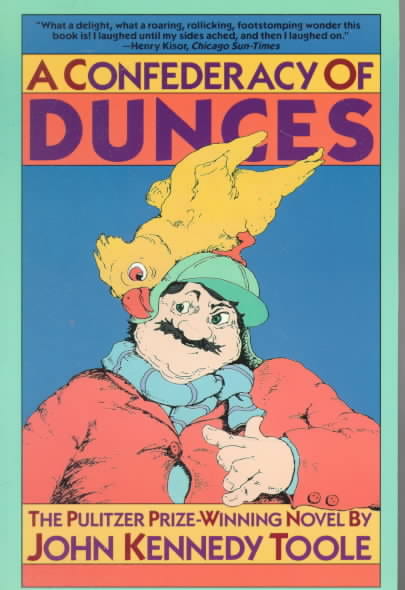
A Confederacy of Dunces


An all time classic comic novel, A Confederacy of Dunces by John Kennedy Toole is also a New Orleans classic. I read this book before I ever imagined living in New Orleans, and it painted an amazingly vivid picture of a place I became determined to visit someday.

The novel concerns the comic exploits of Ignatius J. Reilly, indelible resident of Uptown New Orleans and sufferer of chronic 'valve' problems. Ignatius still lives with his mother although he is thirty and spends his days writing in his journal about the shortcomings of the rest of humanity. Ignatius is a man out of time; a lover of geometry and theology, a hater of popular culture. He attends movies in order to make fun of them. In other words, he wallows in the very material he finds so offensive. He is agoraphobic, a slob, and has delusions of grandeur.

The book is more of an extended character study of Ignatius and New Orleans than it is a traditional plot arc. We meet the denizens of New Orleans, Myrna (Reilly's sometime girlfriend), the long suffering mother, and a bevy of oddball characters. Having lived in New Orleans for over ten years, I have to say that its depictions are incredibly accurate in all their hilarity. Ignatius' attempts at gainful employment (as a hot dog vendor and in a pants factory amongst others) are hilarious enough to sustain the novel.

One of the amazing things about this novel is the route it took to publication. Toole was a young New Orleanian who committed suicide in 1969. His mother found the smeared carbon copied manuscript amongst his effects and in the later 1970s sought out noted author Walker Percy and badgered him into reading a novel by her dead son. Percy did so reluctantly, but found himself more and more entranced as he read on. Using his connections and influences, the book was finally published in 1980 and won the Pulitzer Prize for Literature the following year.

I have purchased and give this novel away at least a half dozen times. I have not read it for several years but plan to reread it for the 4th or 5th time this summer. Simply brilliant, and a top ten favorite for me.

Ignatius J. Reilly is such a part of New Orleans culture, you can visit his bronze image on Canal Street:

The Vicar of Wakefield


Oliver Goldsmith's The Vicar of Wakefield is about as representative of the English 18th century novel as you can get. It's all here: the picaresque setting, the hidden identities, the misunderstandings, the villain's comeuppance, and the tidy, happy ending. The novel was a favorite in Britain for several generations, and is name checked in works by Dickens and Austen, among others.

The titular character is Dr. Primrose, who serves as vicar in an idyllic country parish. He and his wife Deborah have six wonderful children and have the love and respect of their parishioners. However, a financial setback sets the family on the road to hard times and increasing poverty. They are aided by a variety of characters, including Squire Thornhill, the local land magnate. They are also befriended by Mr. Burchell, who becomes a close family friend. Thornhill takes an interest in the Vicar's daughters and eventually kidnaps one of them. It seems the Squire is a serial 'marry 'em, disgrace 'em and leave 'em' type. Misfortune continues to fall as the Vicar's home burns down, but just as the situation seems irredeemable, all is not only set straight, but the virtuous are rewarded.

I enjoyed the novel for the reason that I am fascinated by contemporary accounts of life in past times. This definitely wouldn't be for everyone's taste, but if you like Dickens, Austen, Shelley, or their contemporaries, it is worth a look to see where their inspiration came from.

Everything Is Illuminated


If it seems like I'm reading at an incredible pace with all of these posts, I'm not- I'm just catching up by blogging about some of the books I read over the past several months but didn't have a chance to post about.

I don't know why it took me so long to tackle Everything is Illuminated. I read Jonathan Safran Foer's second book, Extremely Loud and Incredibly Close a few years ago and absolutely loved it. That book was one of the first that used September 11 as a background for the plot and it was a beautiful book.

Everything is Illuminated concerns a young Jewish man (also named Jonathan Safran Foer) who travels to Ukraine in order to learn about his family's heritage and specifically to look for a woman credited in family lore with saving his grandfather during World War II. Arriving in Ukraine, he is met by Alex, a young Ukranian, and Alex's grandfather who will serve as his guides, translators, and chaffeurs. Also along for the ride is Sammy Davis Jr., Jr., the family dog, whom Alex lovingly refers to as a "deranged seeing eye bitch".

The story is told through Alex's narrative and letters to Safran Foer, as well as through a book in progress that Safran Foer is writing regarding his family's history in the semi-fictional village of Trachimbrod. These elements are skillfully woven together, although the device feels a bit self-conscious at times.

One of the major charms of the novel comes in the character of Alex, or more specifically, Alex's broken English and syntax. His writing reminds me of how some of my students will use 'big' words that are synonyms for his intended meaning, and yet somehow miss the mark. Once you capture Alex's cadence, you are in for some laugh out loud moments. This is actually quite a funny novel, but one that also reminds us of the atrocities of the second World War and the lasting damages that resulted from it.

I liked this book, although I liked the follow up novel more. Safran Foer is clearly a very talented writer, but some of this was too clever by half. The novel was turned into a film with Elijah Wood and also won a Jewish Book Award for Fiction.