Sunday, April 12, 2009

Jealousy


'Post modern' novels can fall into a couple of different categories: self-indulgent claptrap or winning and interesting experiments. Alain Robbe-Grillet's brief novel Jealousy falls squarely into the latter for me.

This brief novel is an experiment in first person narrative that is fantastically interesting, and to me, successful. The novel's brevity is essential- the conceit would be unsustainable for a longer, more involved work.

The action centers around an unnamed narrator who lives on a banana plantation with his wife, A. The story is told from the first person, but Robbe-Grillet never uses the first person pronoun 'I'. The narrator clearly has deep concerns about his wife and the owner of a neighboring plantation, Franck. Although we are never privy to his internal monologue or his interpretations or thoughts about the situation, the narrator obsessively and in great detail describes not only his physical surroundings but a series of encounters between his wife and Franck that can be seen as evidence of an affair, or.....as nothing at all. Incidents are described several times in increasing details, cleverly mimicking the way an obsessed and jealous person will replay trivial events over and over in his or her mind.

The real trick of this novel is that in using flat, unemotional detailed descriptions, one of the most turbulent and passionate emotions is ultimately described. Jealousy is passion; obsession is detailed analysis, and the author neatly shows the two to be one and the same.

This is another book that is probably best read in one sitting. Not to everyone's tastes, but a great change of pace for me.

The Crying of Lot 49


Thomas Pynchon's The Crying of Lot 49 is a trip, in many senses of the word. It feels like an acid trip, contains a number of actual journeys, and throws the reader off balance constantly as if he or she has stumbled on a buckle in the sidewalk. Thanks to Lurker Mike for encouraging me to read this remarkable book.

Pynchon's style is a barrage of imagery and sensation, rarely pausing for the reader to catch up. There is a tremendous forward momentum to the book, which makes me recommend that it be read in one sitting. I can't imagine having to throw my mind back into this narrative after leaving it.

The story revolves around Oedipa Maas, a woman who has been named executor of her dead ex-lover's will. In carrying out her duties, she is caught up in the quest to find out if a secret mail-carrying society exists or not. Doesn't sound like much, but Pynchon's prose is dense and, at times, laborious. Just when you think his grasp of sentence structure and language has gone too far, he uses a quick plot point to pull you back into the general flow of the plot. His characters have whimsical names (Ghengis Cohen, etc.) and the puns are plentiful and absurd. The long description of a play within the story (which sets the stage for the second half of the story) is reminiscent of Hamlet's 'The Mousetrap' device. Pynchon's apparent knowledge of a variety of topics had me scrambling to Wikipedia time and again to see what was fact and what was fiction.

This book (published in 1966) seems to take the piss out of the 1960s counterculture and wallow in it at the same time. Oedipa's paranoia and the situations she finds herself in reflect the times very well, especially for a novel that was contemporary to the events depicted. Pynchon riffs on the Beatles, Nabokov, Elvis Presley, and various lifestyle choices in California during this time.

Most aficionados of Pynchon say that this book is the best entry point. It is short and relatively easy to follow once you get the hang of it. It does make me both anxious and nervous to tackle his longer works.

I can't imagine reading a book like this very often, but I have no doubt I'll return to this one over the years. Pynchon's work has a wiki devoted to it, which may be helpful when tackling his novels.

Saturday, April 11, 2009

Watchmen


I was a rabid comic book fan in the late 70s and early 80s. I contracted pneumonia when I was in the 4th or 5th grade and was bedridden for a couple of weeks. My mom started bringing me comic books to help me pass the time. I became addicted.

I was partial to Marvel superhero titles like the Fantastic Four, the Avengers, Iron Man, Spider Man, and the rest. After my recovery I began to spend every cent I had on comics. I subscribed to 8 or 10 titles and bought several more from the drug store or comic shop every month. I harbored fantasies of becoming a comic book artist and spent countless hours sketching my favorites into a stack of notebooks.

As I entered my early teens, two things happened that resulted in my waning interest in comics. The price went up, and titles I'd been paying 35 cents for were suddenly 75 cents or even a dollar. I also discovered a new passion: rock and roll. The end result was the comics being boxed up and largely forgotten as of 1982 or 83.

After having read Watchmen, I wish I would have hung in there a little longer. Alan Moore and Dave Gibbons' 12 part series was released over 1986 and 1987 and it is a genre-defying/genre-defining masterpiece.

I am very late to the party here, so I will eschew a long plot analysis. Suffice it to say that the series revolves around a group of masked adventurers who have been outlawed by the authorities. The murder of one of them (The Comedian) leads to a suspicion by another (Rorschach) that the 'masks' are being targeted by a party unknown. This sets into motion an amazing tale that encompasses 40 plus years of alternate U.S. and world history. Set against the backdrop of the Cold War and the escalating tensions between the U.S. and the U.S.S.R., Watchmen dares to suggest what extreme measures may have been needed had things not gone as they did.

The graphic novel set the standard for the comics form and (along with other works by Moore and by Frank Miller) elevated it to an art that was worthy of discussion beyond the playground. The flaws of the heroes were a culmination of the character flaws that Stan Lee built into his classic Marvel characters of the 1960s, but took them to an entirely new level. Each of the main protagonists in Watchmen helps to flesh out contrasting worldviews, from the black and white certainties of Rorschach to the right wing jingoism of the Comedian to the Utopian liberalism of Ozymandias. None of this views are left unskewered by Moore in his tight story telling. And, in an already incredibly rich and detailed narrative, he and Gibbons add in a parallel tale from a fiction pirate comic to help underscore and illustrate the issues faced by many of the main characters. At the end of the majority of the issues there was also supplemental prose, often in the form of articles or letters, that helped to flesh out the back stories of many of the characters. Moore's ability to write about everything from ornithology to quantum physics is amazing.

The artwork is nuanced and incredibly sympathetic to the tale being told. How Gibbons was able to pack so much detail into 9 frames a page is beyond me. While I am partial to the more realistic styles of Frank Miller or Jim Starlin, I can't picture anyone doing a better job here than Gibbons.

I saw the film version of Watchmen first, and I'm not sure how that impacted my enjoyment of this novel. I can say that the film was perfectly cast for the most part, and I am now really excited for the release on DVD so I can watch it again.

Saturday, March 28, 2009

The Stranger


Camus' The Stranger is a classic of existential lit and has no doubt been read by just about everyone who has ever been an undergraduate at any university in the world.

For anyone who hasn't read it, The Stranger is a compact tale about a young French-Algerian, Meursault, who serves as narrator and the literary embodiment of existential philosophy (although Camus never considered himself to be an existentialist). At the outset of the novel, Meuersault's mother has died and he travels to the nursing home she lived in to see to her funeral. Afterward, he returns to his normal life, normal job, and normal pursuits. He strikes up a relationship with a young woman and befriends a shady man who invites him to the beach. During this trip, a seemingly random encounter with some Arab men leads to murder, and Meursault finds himself in jail awaiting trial.

The crux of the novel is Meursault's realization of the absurdity of life and his belief that the end is the end and nothing that happens really matters. His belief system and seeming lack of remorse or concern about his own fate paints him in an unflattering light before the members of the judicial system. Still, it is not the crime he has committed that condemns him in society's eyes; rather it is his ambivalence towards the death of his mother that society cannot understand or allow to go unpunished.

The version of The Stranger I read is not the classic English translation from Gilbert, but an American translation from Matthew Ward that appeared in 1988. Camus had written that he had intended The Stranger to be written in the 'American' style of James Cain or Dashiell Hammett with short compact sentences and an overtone of though guy swagger. Ward's translation attempts to capture this style, and for me, is successful.

The Stranger is a quick read for a rainy day. I'd also recommend The Plague by Camus.

Sunday, March 15, 2009

Fingersmith


Sarah Waters' Fingersmith is about as engrossing as a novel can get for me. It is set in the Victorian Era, features a terrific mystery, and has plot twists that actually caused me to gasp out loud once or twice.

Our initial narrator, Sue, is an orphan who lives with a group of thieves in London. Mrs. Sucksby has raised her from infancy after her mother was condemned as a murderess and hung. The dashing ne'er-do-well Gentleman convinces Sue to help him run an elaborate con. Maud Lilly is a young heiress and orphan who will come into wealth once she marries. She is isolated at her strange uncle's house in the country and Gentleman has found a way to weasel himself into the household. Sue is to take a commission as Maud's maid in order to help convince Maud to marry Gentleman. Once the marriage is complete, they will arrange for Maud to be committed to a madhouse and share her fortune.

I won't discuss the plot in any more detail than this as the surprise elements are important to the enjoyment of the novel. There are enough twists and turns to satisfy any fan of the genre. The depictions of the squalor of London and the icy country house are top notch and the plot is riveting. Definitely plan on devoting some uninterrupted time to this one if you choose to read it.

Highly recommended for those who enjoy a good twisted mystery. This novel was shortlisted for several major awards.

Monday, March 2, 2009

The Lambs of London


The Lambs of London is a slim novel based somewhat on historical fact. The author, Peter Ackroyd, is an author noted for not only his fiction but his biographies of Dickens, Blake, Shakespeare and others. Here Ackroyd blends fact and fiction as he utilizes the stories of real people Charles and Mary Lamb and William Henry Ireland.

The novel focuses first on Charles, a young man who lives with his family and works for the East India company. Charles is an aspiring writer, a lover of Shakespeare, and quite often, a drunk. His older sister Mary is socially awkward but is also infatuated with the 15th and 16th century dramatists. They live with their parents: their mother, a somewhat bitter woman, and their father who has been mentally incapacitated following some kind of a stroke years previously.

Into their lives comes Ireland, a very young man who operates a bookstore with his father. Ireland has met a mysterious benefactor who allows him to go through her departed husband's extensive collection of papers. Ireland recovers a will and other legal documents that are verified to be Shakespeare's. Scholars and enthusiasts are excited, but nothing prepares them for the day Ireland shows up with the draft of an unknown play. Again, experts verify it as Shakespeare's, although there are some who disagree. Ireland decides to mount the play, and his burgeoning romance with Mary Lamb seems to make his life complete. However, Mary's shaky mental health, William's relationship with his opportunist father, and questions about his benefactor and the veracity of the play begin to cause everything to fall apart.

As a novel, I found this to be somewhat anti-climactic. While it is well-written, it never fully engaged me. Much more interesting are the actual histories of these characters. All of them were real people, but there is no evidence that any of their paths actually crossed. Charles and Mary Lamb wrote a well-known book of Shakespeare for children, battled against mental health issues, and experienced family tragedy. You can look at the story of William Henry Ireland here, but I won't go into detail as it would act as a plot spoiler.

Ackroyd did a great job in coming up with the premise of this historical fiction, but the execution leaves it a little flat. Still, this would hold interest for any Shakespeare enthusiast.

The Blind Assassin


Margaret Atwood was another author I'd heard a lot about but I hadn't gotten around to reading one of her books until I picked up The Blind Assassin. Apparently, Atwood has been labeled as a science fiction writer, a label she bristles at. I remember one of her books, The Handmaid's Tale, was made into a well-received movie a few years ago.

The Blind Assassin is a story within a story within a story. If that puts you off, don't let it. Although there are parts of this story that unwrap mysteriously, it is the author's intent and not just a confusing structure to the novel. It contains elements of mystery, tragedy, drama, and, yes, science fiction.

The novel (which won the Booker Prize 8 or 9 years ago) centers around Iris Chase Griffin, a Canadian woman whose family were once preeminent manufacturers of gloves and other garments until the depression and hard times caused a slow slide from wealth. Iris and her sister Laura are left to be raised by their father and servants after their mother's untimely death. As the narrative of the sisters' lives unfolds, we are introduced to a story within the story, a tale of two lovers meeting in clandestine locations, the man in the relationship improvising a science fiction story that has kept the woman enthralled for months.

Iris' sister Laura dies in a car accident and shortly afterward, her husband is found dead in a sail boat. Are the two incidents related? And who are the lovers in the story 'The Blind Assassin' (revealed to be a posthumous work of Laura's)?

Atwood is a brilliant writer. The plot was well-planned out and engrossing. She is able to skillfully weave the narratives from the 1930s and 40s into the present day as well as including the cut-aways to the story within the story. A tale of identity, secrets, trust, and family, I had a hard time putting this down. This novel was deeply satisfying, deserving of its accolades, and an excellent way to while away a couple of afternoons.

Sunday, January 18, 2009

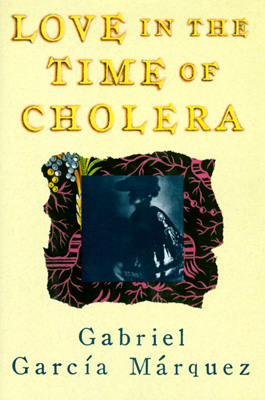
Love in the Time of Cholera


One of the things I like about following 'The List' is that it encourages me to finally read books by authors whose work I am familiar with, but have not read. Toni Morrison was one such author and Gabriel Garcia Marquez is another. I read his non-fiction News of a Kidnapping several years ago and enjoyed it very much, but this was my first foray into his fiction.

Love in the Time of Cholera is one of Marquez's best known works. It has been an Oprah choice, a major motion picture, and is the book people seem to mention most often in relation to this Colombian writer. The story literally covers the lifetime span of the major characters, the lovesick Florentino Ariza and his fifty year obsession with Fermina Daza. The book takes place in the late nineteenth and early twentieth century in an unnamed city on the Mediterranean. Florentino Ariza was the youthful suitor of Fermina Daza who took great pleasure in clandestine correspondence and hopeful talk of the future with Florentino. However, maturity and events lead her instead to marry Dr. Juvenal Urbino, a well-connected local doctor and philanthropist. Florentino Ariza decides to 'wait' for Fermina Daza, hoping that someday, should the good doctor die, she will eventually be his. Florentino has 600 'temporary' flings while waiting for her and leads what appears to be a conventional life to the outside world. However, his entire existence is based around waiting. And waiting. And waiting for Fermina Daza.

The book is a beautiful but challenging read. There is almost no dialogue and the detailed descriptions can be off-putting for some readers. I found that as long as I had a solid chunk of time to devote to it, the novel was great to read. This is definitely not one to pick up in dribs and drabs.

The best thing about this book for me was the subtext. On the surface, it is a relatively straight-forward meditation on the power and endurance of love. Still, I feel that there is a lot more happening than that. The character of Florentino Ariza inspires our sympathy, but when his actions are looked at objectively, he comes off more like a deranged stalker and terrible user of women- not the romantic figure he cuts on a surface reading. The book also tackles some of the enduring questions about old age and the many different faces of love. Definitely worthwhile to read, and one I've spent a lot of time thinking about since I put it down.

Saturday, January 3, 2009

2008 Roundup

By my calculations, I read 26 books from 'The List' this year, plus another half dozen or more that were not on the list. Not bad considering I didn't get started in earnest until late spring. This year I'll need to make up for some lost ground. I'm most of the way through 'Love in the Time of Cholera' right now and received several more books for Christmas.

I am working from the first edition list of 1001 Books You Should Read Before You Die. There was an updated version this year that changed several of the books, but I figure I'll stick with the one I started with.

It has been a great year of reading and I'm looking forward to seeing what new authors I'll discover this year.

Song of Solomon


Toni Morrison is another lion of modern literature. Although her output is modest compared to some others of her generation, the quality of that output was high enough for her to earn just about every literary award there is, including the Nobel Prize in Literature. Still, as with many other authors of her caliber, I had yet to read any of her work until this year.

Song of Solomon is an amazing book and I'm glad it was the first Toni Morrison novel I read. The book is really about identity, especially identity for African Americans who are only able to trace their lineage back so far. The dedication reads, "The fathers may soar And the children may know their names".

The story concerns the Dead family: Macon, his wife, his son, and his two daughters in addition to his sister and her daughter and granddaughter. The main character is son 'Milkman' Dead (so named because of the fact that he breastfed until he could stand on his own feet). The story follows Milkman throughout his life from his younger days as a constant source of disappointment to his father through his joining and maintaining the family business and finally through his search for his grandfather's true identity. Along the way we meet an amazing cast of characters: First Corinthians and Magdalene called Lena, Milkman's sisters; Pilate, his semi-divine aunt; her daughter Ruth and her granddaughter Hagar who falls hopelessly and dangerously in love with Milkman.

Milkman's best friend Guitar offers a contrast to Milkman in both mission and temperament. While Milkman spends the majority of the book thinking of his own needs and trying to get ahead, Guitar has been led to a different path. Guitar belongs to a group that is trying to level the playing field between whites and blacks, with a surprising way of how to accomplish that.

The ending is somewhat ambiguous, but very satisfying. Milkman, facing Guitar down, learns to truly embrace the legacy of his grandfather's people as he learns to fly.

The story of this novel is excellent, but it is Morrison's prose that makes it so fantastic to read. It takes a couple dozen pages to fall into her cadence, but once you do, the story flows by like a river. I read a lot of books this year, but this one will definitely stand out in my mind for many years to come.