Monday, March 2, 2009

The Lambs of London


The Lambs of London is a slim novel based somewhat on historical fact. The author, Peter Ackroyd, is an author noted for not only his fiction but his biographies of Dickens, Blake, Shakespeare and others. Here Ackroyd blends fact and fiction as he utilizes the stories of real people Charles and Mary Lamb and William Henry Ireland.

The novel focuses first on Charles, a young man who lives with his family and works for the East India company. Charles is an aspiring writer, a lover of Shakespeare, and quite often, a drunk. His older sister Mary is socially awkward but is also infatuated with the 15th and 16th century dramatists. They live with their parents: their mother, a somewhat bitter woman, and their father who has been mentally incapacitated following some kind of a stroke years previously.

Into their lives comes Ireland, a very young man who operates a bookstore with his father. Ireland has met a mysterious benefactor who allows him to go through her departed husband's extensive collection of papers. Ireland recovers a will and other legal documents that are verified to be Shakespeare's. Scholars and enthusiasts are excited, but nothing prepares them for the day Ireland shows up with the draft of an unknown play. Again, experts verify it as Shakespeare's, although there are some who disagree. Ireland decides to mount the play, and his burgeoning romance with Mary Lamb seems to make his life complete. However, Mary's shaky mental health, William's relationship with his opportunist father, and questions about his benefactor and the veracity of the play begin to cause everything to fall apart.

As a novel, I found this to be somewhat anti-climactic. While it is well-written, it never fully engaged me. Much more interesting are the actual histories of these characters. All of them were real people, but there is no evidence that any of their paths actually crossed. Charles and Mary Lamb wrote a well-known book of Shakespeare for children, battled against mental health issues, and experienced family tragedy. You can look at the story of William Henry Ireland here, but I won't go into detail as it would act as a plot spoiler.

Ackroyd did a great job in coming up with the premise of this historical fiction, but the execution leaves it a little flat. Still, this would hold interest for any Shakespeare enthusiast.

The Blind Assassin


Margaret Atwood was another author I'd heard a lot about but I hadn't gotten around to reading one of her books until I picked up The Blind Assassin. Apparently, Atwood has been labeled as a science fiction writer, a label she bristles at. I remember one of her books, The Handmaid's Tale, was made into a well-received movie a few years ago.

The Blind Assassin is a story within a story within a story. If that puts you off, don't let it. Although there are parts of this story that unwrap mysteriously, it is the author's intent and not just a confusing structure to the novel. It contains elements of mystery, tragedy, drama, and, yes, science fiction.

The novel (which won the Booker Prize 8 or 9 years ago) centers around Iris Chase Griffin, a Canadian woman whose family were once preeminent manufacturers of gloves and other garments until the depression and hard times caused a slow slide from wealth. Iris and her sister Laura are left to be raised by their father and servants after their mother's untimely death. As the narrative of the sisters' lives unfolds, we are introduced to a story within the story, a tale of two lovers meeting in clandestine locations, the man in the relationship improvising a science fiction story that has kept the woman enthralled for months.

Iris' sister Laura dies in a car accident and shortly afterward, her husband is found dead in a sail boat. Are the two incidents related? And who are the lovers in the story 'The Blind Assassin' (revealed to be a posthumous work of Laura's)?

Atwood is a brilliant writer. The plot was well-planned out and engrossing. She is able to skillfully weave the narratives from the 1930s and 40s into the present day as well as including the cut-aways to the story within the story. A tale of identity, secrets, trust, and family, I had a hard time putting this down. This novel was deeply satisfying, deserving of its accolades, and an excellent way to while away a couple of afternoons.

Sunday, January 18, 2009

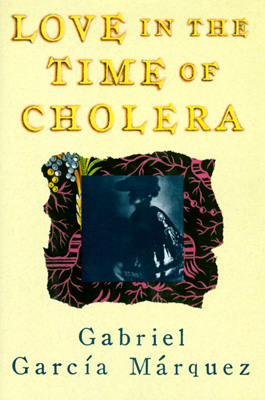
Love in the Time of Cholera


One of the things I like about following 'The List' is that it encourages me to finally read books by authors whose work I am familiar with, but have not read. Toni Morrison was one such author and Gabriel Garcia Marquez is another. I read his non-fiction News of a Kidnapping several years ago and enjoyed it very much, but this was my first foray into his fiction.

Love in the Time of Cholera is one of Marquez's best known works. It has been an Oprah choice, a major motion picture, and is the book people seem to mention most often in relation to this Colombian writer. The story literally covers the lifetime span of the major characters, the lovesick Florentino Ariza and his fifty year obsession with Fermina Daza. The book takes place in the late nineteenth and early twentieth century in an unnamed city on the Mediterranean. Florentino Ariza was the youthful suitor of Fermina Daza who took great pleasure in clandestine correspondence and hopeful talk of the future with Florentino. However, maturity and events lead her instead to marry Dr. Juvenal Urbino, a well-connected local doctor and philanthropist. Florentino Ariza decides to 'wait' for Fermina Daza, hoping that someday, should the good doctor die, she will eventually be his. Florentino has 600 'temporary' flings while waiting for her and leads what appears to be a conventional life to the outside world. However, his entire existence is based around waiting. And waiting. And waiting for Fermina Daza.

The book is a beautiful but challenging read. There is almost no dialogue and the detailed descriptions can be off-putting for some readers. I found that as long as I had a solid chunk of time to devote to it, the novel was great to read. This is definitely not one to pick up in dribs and drabs.

The best thing about this book for me was the subtext. On the surface, it is a relatively straight-forward meditation on the power and endurance of love. Still, I feel that there is a lot more happening than that. The character of Florentino Ariza inspires our sympathy, but when his actions are looked at objectively, he comes off more like a deranged stalker and terrible user of women- not the romantic figure he cuts on a surface reading. The book also tackles some of the enduring questions about old age and the many different faces of love. Definitely worthwhile to read, and one I've spent a lot of time thinking about since I put it down.

Saturday, January 3, 2009

2008 Roundup

By my calculations, I read 26 books from 'The List' this year, plus another half dozen or more that were not on the list. Not bad considering I didn't get started in earnest until late spring. This year I'll need to make up for some lost ground. I'm most of the way through 'Love in the Time of Cholera' right now and received several more books for Christmas.

I am working from the first edition list of 1001 Books You Should Read Before You Die. There was an updated version this year that changed several of the books, but I figure I'll stick with the one I started with.

It has been a great year of reading and I'm looking forward to seeing what new authors I'll discover this year.

Song of Solomon


Toni Morrison is another lion of modern literature. Although her output is modest compared to some others of her generation, the quality of that output was high enough for her to earn just about every literary award there is, including the Nobel Prize in Literature. Still, as with many other authors of her caliber, I had yet to read any of her work until this year.

Song of Solomon is an amazing book and I'm glad it was the first Toni Morrison novel I read. The book is really about identity, especially identity for African Americans who are only able to trace their lineage back so far. The dedication reads, "The fathers may soar And the children may know their names".

The story concerns the Dead family: Macon, his wife, his son, and his two daughters in addition to his sister and her daughter and granddaughter. The main character is son 'Milkman' Dead (so named because of the fact that he breastfed until he could stand on his own feet). The story follows Milkman throughout his life from his younger days as a constant source of disappointment to his father through his joining and maintaining the family business and finally through his search for his grandfather's true identity. Along the way we meet an amazing cast of characters: First Corinthians and Magdalene called Lena, Milkman's sisters; Pilate, his semi-divine aunt; her daughter Ruth and her granddaughter Hagar who falls hopelessly and dangerously in love with Milkman.

Milkman's best friend Guitar offers a contrast to Milkman in both mission and temperament. While Milkman spends the majority of the book thinking of his own needs and trying to get ahead, Guitar has been led to a different path. Guitar belongs to a group that is trying to level the playing field between whites and blacks, with a surprising way of how to accomplish that.

The ending is somewhat ambiguous, but very satisfying. Milkman, facing Guitar down, learns to truly embrace the legacy of his grandfather's people as he learns to fly.

The story of this novel is excellent, but it is Morrison's prose that makes it so fantastic to read. It takes a couple dozen pages to fall into her cadence, but once you do, the story flows by like a river. I read a lot of books this year, but this one will definitely stand out in my mind for many years to come.

Saturday, December 13, 2008

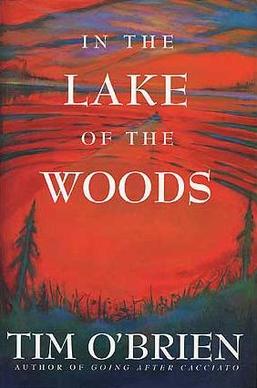
In the Lake of the Woods


Tim O'Brien is a great writer. It's not just in the actual mechanics of his writing; it's in the tone he is able to set. In the novel In the Lake of the Woods, the tone is regret, loss and sadness tinged with mystery and the unknown.

The novel is about a Minnesota politician, John Wade, who has just lost a Senate election. He and his wife Kathy move to a lake house in northern Minnesota to get away from the stress of the election and to recover after a bitter disappointment. O'Brien unfolds the Wade's story in flashbacks, from John's childhood (and the development of his alter-ego, Sorcerer) to his meeting and early days with Kathy, to his war experiences in Vietnam and on to the multitude of secrets the two share.

One morning, John wakes up and Kathy is gone. After consulting with the friendly older couple who live nearby, the Rasmussens, he decides to report it to the police. For two weeks search parties are organized and John becomes a figure of increasing interest to the police. Frightening flashbacks lead the reader to believe that John may have killed Kathy.

O'Brien skillfully weaves several plausible scenarios for Kathy's disappearance. The ending is ambiguous, but this book stayed with me for a long time after reading.

O'Brien's novel The Things They Carried was nominated for the Pulitzer Prize, and he is probably the pre-eminent novelist of the Vietnam generation working today. I have also read July, July, which is also excellent.

This book has overtones of mystery, but I certainly would not consider it a 'mystery novel'. I first read this 3 or 4 years ago and am going to re-read it soon.

Sunday, November 23, 2008

Cigarettes


This is an unpleasant book about unpleasant people.

In my opinion, the key to enjoying a novel is to find a character you can identify with or at least relate to. It doesn't matter if the action is set in the past, present or future, whether it is in the United States, Russia, or outer space, whether the characters are male, female, or even human. There just needs to be a point of entry for our empathy. Harry Mathew's Cigarettes did not provide this point of entry for me.

The novel covers a span of 30 or so years and the action jumps around between decades as it focuses on the relationships between a large cast of characters, all of whom could be classified as the idle rich of New York and environs. While the plot revolves around a painting that unites the characters in one way or another, the book is really an opportunity for Mathews to explore the intermingled relationships between these self-obsessed and unlikable characters. Each chapter focuses on two of the characters (and are titled as such: "Walter and Elizabeth", "Allen and Maud", etc.). Their social anxieties, sexual practices, and personal failings are explored ad nauseum. The names were so similar I began to get confused about who was who (Allen, Owen, Pauline, Priscilla, etc.)

Evidently Mathews belongs to a French salon that experiments by using algorithms and other mathematical concepts in order to create plot structures. It is an interesting experiment, but to be honest, I could care less. The artifice is exposed when there is nothing else there to interest the reader (or, at least, this reader).

Mathew's style is very sparse. Large events are covered in a few sentences and there is relatively little dialogue. I felt like I was reading this book forever.

If I may borrow a joke from someone on another blog, Cigarettes was, indeed, a drag.

Saturday, November 15, 2008

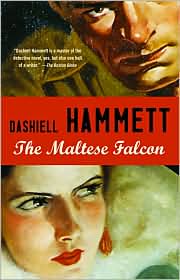
The Maltese Falcon


Here he is in his full glory: the hard-boiled private detective, a man of action and a man who follows his own code. While he may be a throwback, the character of Sam Spade epitomized what it meant to be a man in a man's world: drinker of liquor, fighter of men, lover of woman, and solver of crimes (and not necessarily in that order). I don't know much about the reaction to Dashiell Hammett's novel when it was first released, but I imagine that it was not considered proper literature in 1929. The book features a main character who is fairly non-plussed about the murder of his partner, is revealed to have been having an affair with that partner's wife, drinks, seduces young women, and routinely operates outside the authority of the police. In addition, there is a subplot that revolves around homosexuality and scenes that include Spade looking at nude women. No wonder this stuff was called pulp fiction!

The story itself follows Spade's attempts to figure out why so many people are interested in the titular bird, a sculpture that is clearly of value. It opens with the classic set up: a beautiful young woman enters the office of the private eye looking for help in something that she is none too truthful about. Double crosses, imminent personal danger, international miscreants and meddling cops come and go in this textbook plot. The real value of the story is the introduction of one of the most indelible characters in literature and film, Sam Spade himself. Although Hammett wrote other detective novels, this is the only one that features Spade.

Spade is almost symbolic of America's image of itself from the time it was written. Here was a new type of hero- one who rejected the old ways of doing things but still operated on a code of personal honor that was unwavering. While pre-World War I America may have been symbolized by the cowboy, the post war years could similarly be looked at through the prism of Spade; a maverick nation that bucked the trends and brought into being a new way of operating. In addition, Spade presented an ideal for American manhood and the American spirit. He was a solo operator who did things his own way, accepting the consequences for his own decisions. Obviously, Bogart defined the role for the silver screen and other authors and filmmakers have been following the template ever since.

Reading the book posed a challenge in some ways because so many of the plot devices and situations, which were undoubtedly new and fresh at the time, have become such hackneyed cliches it is almost impossible to read with a straight face. Still, if you can place it in its proper context, the novel is fast paced and suspenseful, and is a definite classic for anyone interested in detective fiction.

The Original Hardy Boys series


I'm sure that my experience with the Hardy Boys stories will be a mirror image of that of millions of other people who were raised between the 50s and the 80s. Although the Boys have been around since the 1920s, the books were overhauled in the 50s or 60s in order to get rid of some of the anachronisms that abounded in the earlier titles.

As most people with any interest know, Franklin W. Dixon was actually a nom de plume for a prolific hack writer who also birthed the Nancy Drew series. Only the first twenty books or so were written by the original author, after which they were produced from an anonymous stable of the publisher's writers. Think Brill Building for teen detective lit. The 'classic' series ran for 58 volumes, beginning with The Tower Treasure and ending with The Sting of the Scorpion.

It is easy for me to trace my love of reading back to the Hardy Boys series. As a kid growing up in the 1970s, I lived for these books. The stories had enough action and mystery to be engrossing, but were never frightening. The brothers, Frank and Joe, were just older enough to seem smart and independent without being total aliens to a pre-teen. Frank was sober and steady, Joe was impetuous and action-driven, giving all kids a behavior role model to look up to. Their friends ranged from Chet, the fat farm kid, to Phil Cohen, my first exposure to a Jewish character. I learned lots and lots of vocabulary from these books; words like 'sinister', 'jalopy', and 'estranged' entered my vocabulary.

My mom used to buy new titles for me as an allowance. Instead of cash for doing my chores, I was rewarded with a book. To this day I think of books as a special reward. Thanks mom! This series probably also was the root of my 'completist' nature when it comes to authors and artists.

My favorite titles? Danger on Vampire Trail, The Mystery of Cabin Island, and The Disappearing Floor. As time went by, I began to wonder how the guys could have solved 58 mysteries while still being 17 and 18. How many summer breaks and spring breaks did this school have? That was the beginning of the creep of cynicism that separates our childhood from the later years. I eventually sold the whole collection at a garage sale when I was 12 or 13, another milestone on the road to something. Still, I like to pick one up every now and then and reread it, and when I do, it still takes me back.

Sunday, November 2, 2008

The Shining


Stephen King obviously needs no introduction. An amazing publishing phenomenon, King continues to produce a fairly consistent amount of work, even if he isn't quite as prolific as his 80s and 90s heyday. I have probably read just about everything he's written, with the exception of a few of the later books and the Dark Tower series. King is the source of controversy amongst literary types; his pulpy plots are a little too 'supermarket' for the snobs. Still, I count him as amongst one of the finest storytellers in literary history, and isn't that really what novels are all about? In addition, King's writing has grown richer and richer over the years as he's dabbled in many styles outside the pale of traditional horror.

The Shining was King's third or fourth novel, and arguably the best of the earliest part of his career. I won't go deep into plot details, as anyone with even a passing interest in King's work has probably read the book. Still, the creepy story of a troubled man and his family wintering as caretakers in a secluded Colorado hotel still has enough fright in its pages to keep me up at night. The book contains several hallucinatory and surreal passages and imparts a genuine sense of claustrophobia, much like what the characters in the story were experiencing. Stanley Kubrick's film version has its detractors, but I feel it holds up very well over time, even with Nicholson's over the top performance and the slightly different ending.

It is important to remember that authors like Dickens were often dismissed as hacks in their own time. I believe that King's best work will stand up over time in the same way as that of the most beloved storytellers from the past.