Tuesday, May 12, 2009

Treasure Island


For some reason I have had an aversion to 'children's classics'. Thus, Huckleberry Finn, Tom Sawyer, and their ilk remain unread by me. However, I do like pirates, and so I decided to bite the bullet and check out Treasure Island by Robert Louis Stevenson and I'm glad I did.

There's not much to say about the plot or the characterization. Most of the narrative is breathless action and vivid description surrounding a hunt for hidden treasure on a remote island. What made this so enjoyable for me is that I had no idea how much of our modern pirate image and idiom came from this tale. It's all here: Long John Silver, parrots on the shoulder, peg legs, the Jolly Roger, Davy Jones locker, Yo Ho Ho and a Bottle of Rum...... I can only imagine what a rollicking adventure this was for a young reader near the turn of the century and it's easy to see how this has stood the test of time.

Saturday, May 2, 2009

Under the Skin


I had no idea what to expect when I picked up Michel Faber's Under the Skin. This was a book on the list that I randomly selected when picking out some new books. I expected a detective story or perhaps a psychological thriller based on the title and cover alone.

Under the Skin is a hybrid: thriller, science fiction, mystery, and an animal rights polemic all rolled into one. The novel introduces us to Isserly, a young female who drives the relatively deserted roads of the Scottish Highlands looking for male hitchhikers, specifically those who are robust or well-muscled. Through a series of encounters with these hitchhikers, and the aftermaths of their rides with Isserly, we are slowly exposed to the truth of her identity, motivation, and mission. I won't go any deeper into the plot than that so potential readers can pick up on events on their own. Much of the pleasure in this novel lies in the way the reader is slowly lead into the details of what is actually happening, with new layers added all the time.

This book is creepy. Over the course of reading it, I actually had a couple of mild nightmares based around the events in the book. There is something about Faber's prose that gets, well, under your skin and stays there. I highly recommend this one to anyone who enjoys science fiction, especially the pulpy novels of the sixties and seventies.

What really sets this one apart, however, is the effect it will have on most meat eaters. Our assumptions about identity, souls, and the relative hierarchy of life on this planet are challenged in a variety of ways. Prepare to squirm.

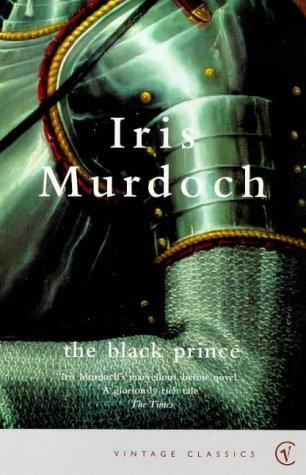
The Black Prince


Don't let the cover fool you- there is nothing medieval about the prince in this story. Published in 1973,The Black Prince is the first novel I've read by acclaimed author Iris Murdoch.

Bradley Pearson is an aging writer and retired tax worker in England. From his first person narrative, we learn of his friendship and rivalry with the far more successful novelist Arnold Baffin and his wife, Rachel. Bradley seems to be experiencing an extended bout of writer's block and plans to summer at a remote cabin near the English seaside. However, before he can escape London, he is accosted by a number of friends, relations, and an ex-wife who bring a variety of problems and situations for Arnold to deal with. In the midst of all this, he discovers he has fallen in love with the very young daughter of Arnold and Rachel, a girl he has known her entire life. This situation leads to a series of events that call into question nearly every event and assumption the reader has made before the ending.

The main body of the narrative is book-ended by an introduction from a 'publisher' and a series of post-scripts from some of the main characters which cast the events in an entirely different light.

I really enjoyed this novel for Murdoch's skill with prose and for the overall story. While the plot was compelling, the narrator's ruminations on topics such as education, art, writing, friendship, love, etc. made it drag a little for me. These diversions are ultimately essential for understanding the nature of his character, but still brought things to a standstill occasionally. Here and there, I found myself skimming, something I don't often do when reading a novel.

Still, I look forward to reading more of Murdoch's work and plan to check out the feature film made about her lifelong romance with John Bayley and her decline from Alzheimer's.

Monday, April 27, 2009

On Beauty


This is the second novel of Zadie Smith's I've read. Smith is a pretty amazing and refreshing talent, but this one didn't hit me with quite the impact that White Teeth did. In fact, this one feels more like a first novel than that one did. One of the things I really marvelled at in White Teeth is the amazing dialog, no small feat considering she had several characters with all types of ethnic, gender, and age backgrounds. The dialog in On Beauty is stilted feeling. Perhaps this is due to the fact that most of the speakers are from academia. Still, few, if any, professors I know speak like they write: stuffy with a verbosity that borders on logghoria.

On Beauty concerns the trials and travails of two diametrically opposed families: The Belseys, an interracial couple with three kids who are the embodiment of liberalism and godlessness, and the Kipps from Trinidad with two 'perfect' children who espouse an extremely conservative, Christian, and anti-affirmative action viewpoint. The families become intertwined through the Christian conversion of Jerome, eldest son of the liberal clan, and his subsequent short lived affair with the daughter, Victoria, of the conservative counterparts. The action centers around Wellington, a fictional Ivy League school near Boston. There is a great deal of talk regarding beauty, the inherent value of art, racial identity, and gender politics, but the core of On Beauty to me is the idea of identity in general. All people, Smith seems to be pointing out, have a public self and a private self. Expectations are based on the public self but every person is different than what the world perceives. Thus we have the 'thug' who is an accomplished poet and budding archivist, the privileged multi-racial child who yearns for black identity, the bastion of conservative thought who is not above adultery, and the reserved virginal girl who is actually a voracious seducer of men.

While this book didn't measure up to the aforementioned debut, it was still an enjoyable story. I look forward to reading just about anything Smith publishes in the future.

Monday, April 13, 2009

The Fall of the House of Usher; The Pit and the Pendulum; The Purloined Letter


I read all three of these stories on my lunch hour today. It is amazing what a body of work Edgar Allan Poe left behind, and how accessible it is. Poe, who died at 40, left a legacy that is still being built upon today in the detective and horror genres.

The thing that I love about The Fall of the House of Usher and The Pit and the Pendulum is how relentless the horror is that Poe establishes in just 13 or 14 pages in each story. His descriptions of the decrepit mansion and the horrible Inquisition pit are enough to turn the stomach and get under the skin. His contemporary Hawthorne was great at this as well- describing inanimate objects and places and making the reader feel as if they can feel, smell, and hear the horror. I was reading these stories in a brightly lit faculty lounge and I swear my skin grew clammy. I love stories like this that are grotesque without being gross.

The Purloined Letter
is another matter entirely. It is a very early detective story, featuring the same protagonist Poe used for The Murders in the Rue Morgue (arguably the first whodunnit in literature). The puzzle, while comparatively rudimentary by today's standards, is still a ground-breaker in terms of the use of criminal psychology in a fictional piece. The logic exercised by the detective would become the basis for Sherlock Holmes, Hercule Poirot, Peter Wimsey, and countless other sleuths of 20th century literature. All in all, a great way to spend a lunch hour!

Sunday, April 12, 2009

Jealousy


'Post modern' novels can fall into a couple of different categories: self-indulgent claptrap or winning and interesting experiments. Alain Robbe-Grillet's brief novel Jealousy falls squarely into the latter for me.

This brief novel is an experiment in first person narrative that is fantastically interesting, and to me, successful. The novel's brevity is essential- the conceit would be unsustainable for a longer, more involved work.

The action centers around an unnamed narrator who lives on a banana plantation with his wife, A. The story is told from the first person, but Robbe-Grillet never uses the first person pronoun 'I'. The narrator clearly has deep concerns about his wife and the owner of a neighboring plantation, Franck. Although we are never privy to his internal monologue or his interpretations or thoughts about the situation, the narrator obsessively and in great detail describes not only his physical surroundings but a series of encounters between his wife and Franck that can be seen as evidence of an affair, or.....as nothing at all. Incidents are described several times in increasing details, cleverly mimicking the way an obsessed and jealous person will replay trivial events over and over in his or her mind.

The real trick of this novel is that in using flat, unemotional detailed descriptions, one of the most turbulent and passionate emotions is ultimately described. Jealousy is passion; obsession is detailed analysis, and the author neatly shows the two to be one and the same.

This is another book that is probably best read in one sitting. Not to everyone's tastes, but a great change of pace for me.

The Crying of Lot 49


Thomas Pynchon's The Crying of Lot 49 is a trip, in many senses of the word. It feels like an acid trip, contains a number of actual journeys, and throws the reader off balance constantly as if he or she has stumbled on a buckle in the sidewalk. Thanks to Lurker Mike for encouraging me to read this remarkable book.

Pynchon's style is a barrage of imagery and sensation, rarely pausing for the reader to catch up. There is a tremendous forward momentum to the book, which makes me recommend that it be read in one sitting. I can't imagine having to throw my mind back into this narrative after leaving it.

The story revolves around Oedipa Maas, a woman who has been named executor of her dead ex-lover's will. In carrying out her duties, she is caught up in the quest to find out if a secret mail-carrying society exists or not. Doesn't sound like much, but Pynchon's prose is dense and, at times, laborious. Just when you think his grasp of sentence structure and language has gone too far, he uses a quick plot point to pull you back into the general flow of the plot. His characters have whimsical names (Ghengis Cohen, etc.) and the puns are plentiful and absurd. The long description of a play within the story (which sets the stage for the second half of the story) is reminiscent of Hamlet's 'The Mousetrap' device. Pynchon's apparent knowledge of a variety of topics had me scrambling to Wikipedia time and again to see what was fact and what was fiction.

This book (published in 1966) seems to take the piss out of the 1960s counterculture and wallow in it at the same time. Oedipa's paranoia and the situations she finds herself in reflect the times very well, especially for a novel that was contemporary to the events depicted. Pynchon riffs on the Beatles, Nabokov, Elvis Presley, and various lifestyle choices in California during this time.

Most aficionados of Pynchon say that this book is the best entry point. It is short and relatively easy to follow once you get the hang of it. It does make me both anxious and nervous to tackle his longer works.

I can't imagine reading a book like this very often, but I have no doubt I'll return to this one over the years. Pynchon's work has a wiki devoted to it, which may be helpful when tackling his novels.

Saturday, April 11, 2009

Watchmen


I was a rabid comic book fan in the late 70s and early 80s. I contracted pneumonia when I was in the 4th or 5th grade and was bedridden for a couple of weeks. My mom started bringing me comic books to help me pass the time. I became addicted.

I was partial to Marvel superhero titles like the Fantastic Four, the Avengers, Iron Man, Spider Man, and the rest. After my recovery I began to spend every cent I had on comics. I subscribed to 8 or 10 titles and bought several more from the drug store or comic shop every month. I harbored fantasies of becoming a comic book artist and spent countless hours sketching my favorites into a stack of notebooks.

As I entered my early teens, two things happened that resulted in my waning interest in comics. The price went up, and titles I'd been paying 35 cents for were suddenly 75 cents or even a dollar. I also discovered a new passion: rock and roll. The end result was the comics being boxed up and largely forgotten as of 1982 or 83.

After having read Watchmen, I wish I would have hung in there a little longer. Alan Moore and Dave Gibbons' 12 part series was released over 1986 and 1987 and it is a genre-defying/genre-defining masterpiece.

I am very late to the party here, so I will eschew a long plot analysis. Suffice it to say that the series revolves around a group of masked adventurers who have been outlawed by the authorities. The murder of one of them (The Comedian) leads to a suspicion by another (Rorschach) that the 'masks' are being targeted by a party unknown. This sets into motion an amazing tale that encompasses 40 plus years of alternate U.S. and world history. Set against the backdrop of the Cold War and the escalating tensions between the U.S. and the U.S.S.R., Watchmen dares to suggest what extreme measures may have been needed had things not gone as they did.

The graphic novel set the standard for the comics form and (along with other works by Moore and by Frank Miller) elevated it to an art that was worthy of discussion beyond the playground. The flaws of the heroes were a culmination of the character flaws that Stan Lee built into his classic Marvel characters of the 1960s, but took them to an entirely new level. Each of the main protagonists in Watchmen helps to flesh out contrasting worldviews, from the black and white certainties of Rorschach to the right wing jingoism of the Comedian to the Utopian liberalism of Ozymandias. None of this views are left unskewered by Moore in his tight story telling. And, in an already incredibly rich and detailed narrative, he and Gibbons add in a parallel tale from a fiction pirate comic to help underscore and illustrate the issues faced by many of the main characters. At the end of the majority of the issues there was also supplemental prose, often in the form of articles or letters, that helped to flesh out the back stories of many of the characters. Moore's ability to write about everything from ornithology to quantum physics is amazing.

The artwork is nuanced and incredibly sympathetic to the tale being told. How Gibbons was able to pack so much detail into 9 frames a page is beyond me. While I am partial to the more realistic styles of Frank Miller or Jim Starlin, I can't picture anyone doing a better job here than Gibbons.

I saw the film version of Watchmen first, and I'm not sure how that impacted my enjoyment of this novel. I can say that the film was perfectly cast for the most part, and I am now really excited for the release on DVD so I can watch it again.

Saturday, March 28, 2009

The Stranger


Camus' The Stranger is a classic of existential lit and has no doubt been read by just about everyone who has ever been an undergraduate at any university in the world.

For anyone who hasn't read it, The Stranger is a compact tale about a young French-Algerian, Meursault, who serves as narrator and the literary embodiment of existential philosophy (although Camus never considered himself to be an existentialist). At the outset of the novel, Meuersault's mother has died and he travels to the nursing home she lived in to see to her funeral. Afterward, he returns to his normal life, normal job, and normal pursuits. He strikes up a relationship with a young woman and befriends a shady man who invites him to the beach. During this trip, a seemingly random encounter with some Arab men leads to murder, and Meursault finds himself in jail awaiting trial.

The crux of the novel is Meursault's realization of the absurdity of life and his belief that the end is the end and nothing that happens really matters. His belief system and seeming lack of remorse or concern about his own fate paints him in an unflattering light before the members of the judicial system. Still, it is not the crime he has committed that condemns him in society's eyes; rather it is his ambivalence towards the death of his mother that society cannot understand or allow to go unpunished.

The version of The Stranger I read is not the classic English translation from Gilbert, but an American translation from Matthew Ward that appeared in 1988. Camus had written that he had intended The Stranger to be written in the 'American' style of James Cain or Dashiell Hammett with short compact sentences and an overtone of though guy swagger. Ward's translation attempts to capture this style, and for me, is successful.

The Stranger is a quick read for a rainy day. I'd also recommend The Plague by Camus.

Sunday, March 15, 2009

Fingersmith


Sarah Waters' Fingersmith is about as engrossing as a novel can get for me. It is set in the Victorian Era, features a terrific mystery, and has plot twists that actually caused me to gasp out loud once or twice.

Our initial narrator, Sue, is an orphan who lives with a group of thieves in London. Mrs. Sucksby has raised her from infancy after her mother was condemned as a murderess and hung. The dashing ne'er-do-well Gentleman convinces Sue to help him run an elaborate con. Maud Lilly is a young heiress and orphan who will come into wealth once she marries. She is isolated at her strange uncle's house in the country and Gentleman has found a way to weasel himself into the household. Sue is to take a commission as Maud's maid in order to help convince Maud to marry Gentleman. Once the marriage is complete, they will arrange for Maud to be committed to a madhouse and share her fortune.

I won't discuss the plot in any more detail than this as the surprise elements are important to the enjoyment of the novel. There are enough twists and turns to satisfy any fan of the genre. The depictions of the squalor of London and the icy country house are top notch and the plot is riveting. Definitely plan on devoting some uninterrupted time to this one if you choose to read it.

Highly recommended for those who enjoy a good twisted mystery. This novel was shortlisted for several major awards.